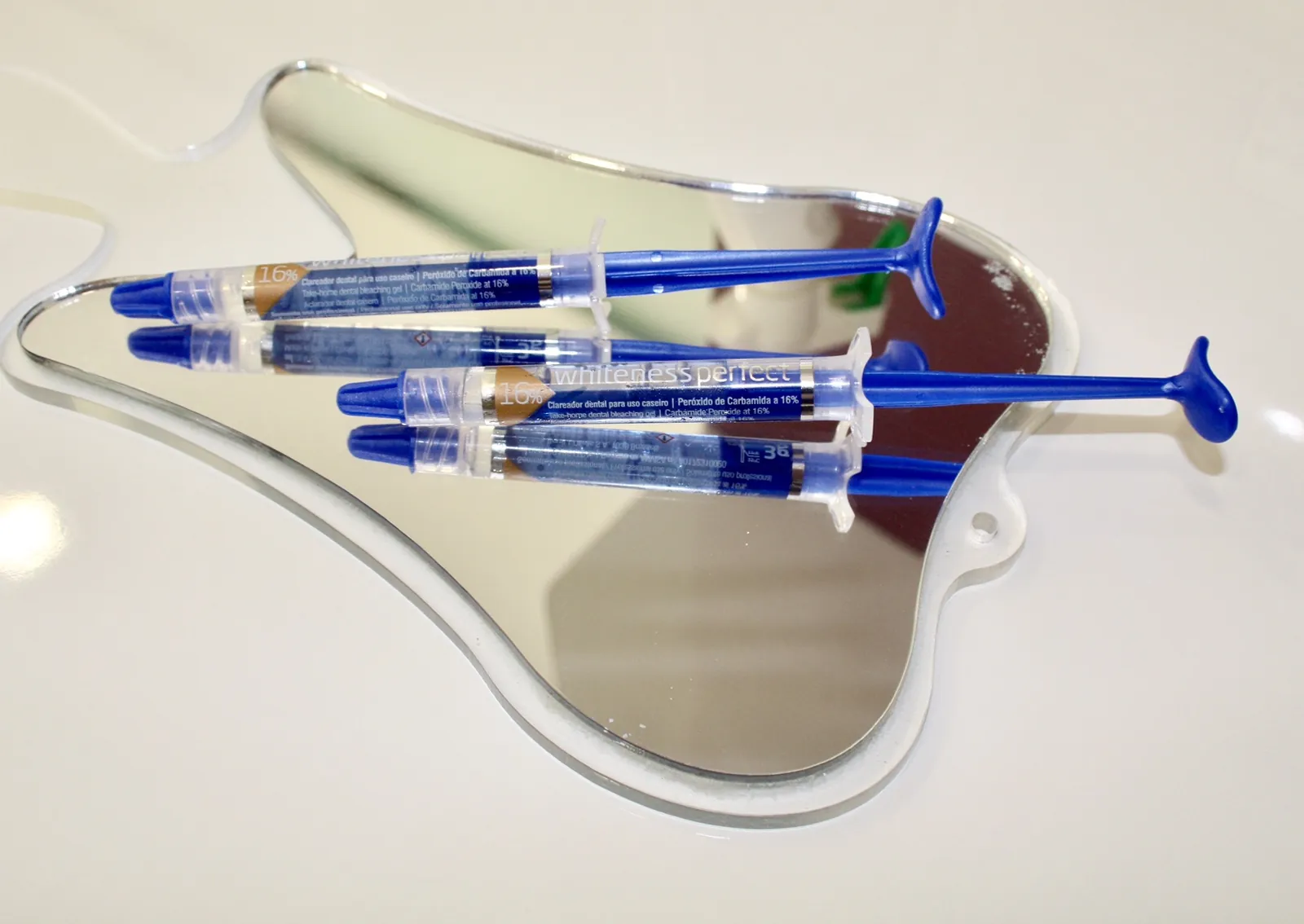
One of the questions we are asked most often is about whitening. There are two kinds: at home and at the dental studio.
Before whitening, a professional cleaning is needed: plaque and tartar are removed with ultrasound and the teeth are polished with air flow (a device that uses water, air and powder under pressure). We discuss whether old fillings, crowns and bridges in the front, visible area should be replaced. The current shade of the teeth is measured with a shade guide. During whitening it is best to avoid food and drink with a lot of colouring, and smoking. Combining whitening at the studio and at home gives very good results.
Whitening at home
Impressions of the upper and lower jaw are taken and sent to the dental laboratory, which makes custom trays for the whitening agent. The patient is given instructions: the amount and the time depend on the whitening system. After 2–3 days there is a check-up to see the progress. Most often the trays with the whitening gel are worn overnight, or for a few hours during the day. The final result is assessed after 10, 12 or 15 days, depending on the system and the result wanted, and compared with the shade before the treatment.
Whitening at the studio (in-office whitening)
- a mouth opener is placed;
- the gums are isolated with a special gel, a barrier against the whitening agent;
- the whitening agent is applied to the teeth and activated with a special light for a set time, depending on the system;
- the gel is removed and the result checked; if it is not enough, the gel is applied again, up to 3 times in one visit.
Both kinds use an agent based on carbamide peroxide or hydrogen peroxide; the difference is the concentration. At the studio it is higher but used for a shorter time, and the result shows straight away. At home a lower concentration is used so as not to burn the soft tissues (gums, lips, tongue, cheeks), and the treatment takes a few hours a day or overnight; the effect shows after 10–12 days.
How long it lasts, and is it safe?
Whitening lasts a long time (years), but how long differs from patient to patient: it depends on eating habits and other habits – food and drink that stain, such as red wine, beetroot, coffee, black tea and cola, and smoking. The more of them, and the poorer the oral hygiene, the sooner the teeth will darken again. Usually a single top-up treatment after 6 months to a year is a good idea.
Both home and studio whitening are painless and harmless. A possible side effect is a short-lived sensitivity to hot and cold, which is why most whitening systems also offer toothpastes or gels for sensitivity after whitening.
Whitening is a cosmetic treatment: the active ingredients of the agent lighten and draw out the stains from the enamel. They do not damage the enamel in any way; they only draw out the organic stains from the enamel and dentine and do not harm the structure of the tooth, especially when the instructions are followed.
-
Whitening gel.